
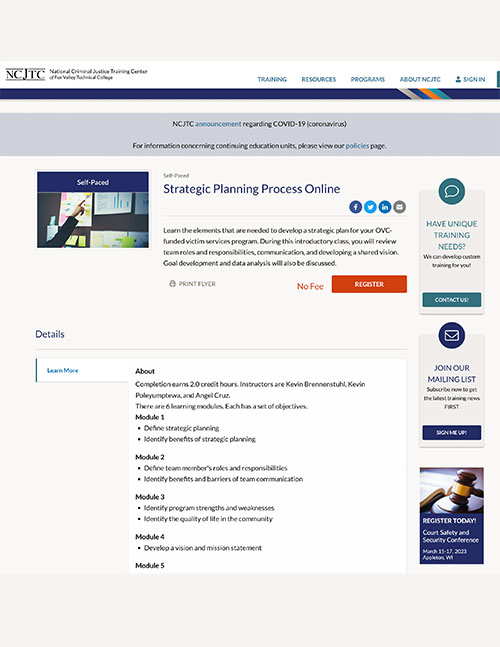
Self-Paced course for Strategic Planning Process Online
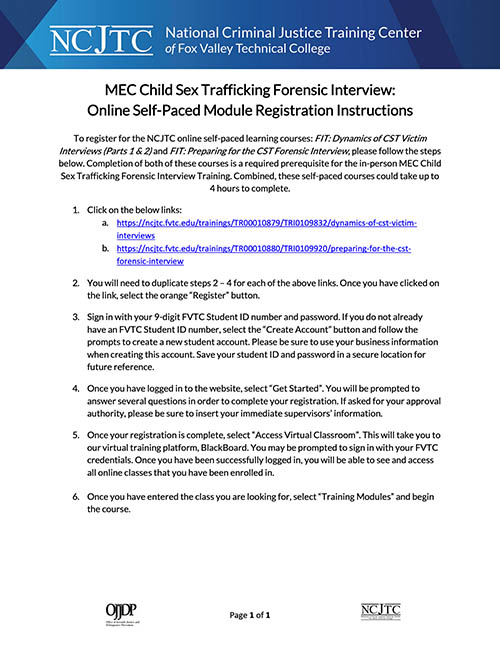
Instructions to register for the On Demand Community and enroll in the Forensic Interview Training (FIT) online courses

Patient form

2020.9.24 Sex Offender Registration Code Policy and Procedure and Form Development 508 Compliant

The crucial role of law enforcement in preparing for the use of evidence by forensic interviewers during a forensic interview will be examined. Good preparation is essential to make the process go smoothly and maximizes positive outcomes for both the victim and the investigation.

How to present evidence to children during a child forensic interview done in both a legal and ethical way will be examined. Learn the process of presenting evidence from the point of view of being able to defend the practice.

Victim Assistance Training Online is a foundational Web-based victim assistance training program that offers victim service providers and allied professionals the opportunity to acquire the essential skills and knowledge they need to more effectively assist victims of crime. VAT Online has four sections: Basics, Core Competencies and Skills, Crimes, and Specific Considerations for Providing Victim Services.

In the modern cyber-world, almost all criminal investigations have an online aspect that can be used to further investigations and more quickly solve otherwise difficult cases. Join us to examine open source online intelligence/information and learn how to leverage free platforms, databases, and web applications to strengthen criminal cases. Uncover little known facts and techniques to optimize results using online search engines and online internet resources, which will support your investigations and prosecutions. Learn how to complete and serve search warrants for a variety of electronic information and databases to further all types of investigations. Develop new skill sets to establish contacts and open-source intelligence networks to provide ongoing criminal and threat intelligence in your jurisdiction.

A task force was created to strengthen community policing and trust among law enforcement officers and the communities they serve. This publication documents task force recommendations, each with action items, organized around six main topic areas or pillars: Building Trust and Legitimacy, Policy and Oversight, Technology and Social Media, Community Policing and Crime Reduction, Officer Training and Education, and Officer Safety and Wellness.

The NASOM Forum was held to bring together a diverse group of experts in the field (including FVTC consultants and SMART Office Senior Policy Advisors in Indian Country) to discuss the program data collected, review the literature summary, and collaborate on creating tribal specific, culturally appropriate resources and programs. As part of the development of the literature review, program inventory, and other written materials, a group of tribal subject matter experts provided a peer-review of all of the documents during the National Forum. This feedback has been incorporated into the final version of this report.