Handout for the Leadership Skills for Effective Community Policing webinar, April 2018.

Discuss the role of the leader in developing organizational, vision, mission, and values, and how important they are in driving community policing. Review internal skills that instill empowerment in the organization and external skills that earn trust throughout the community. Examine the role police can play in leading community problem solving and obtain resources to help implement the strategies discussed during the webinar.

This document provides questions for consideration when seeking to engage community leadership.
PPT Slides for Developing Cognitive, Social and Emotional Skills: Practical Ways to Use Cognitive Behavioral Therapy - 508C
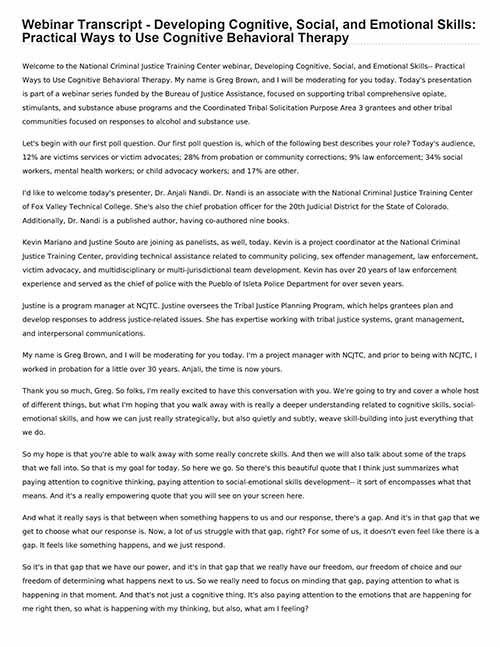
Webinar Transcript for Developing Cognitive, Social and Emotional Skills: Practical Ways to Use Cognitive Behavioral Therapy - 508C
Educating Tribal Leadership - 508 Compliant
Many communities continue to struggle with building an effective CCR to domestic violence, sexual assault, stalking and dating violence that involves every system and community-based stakeholder impacting a case. Ongoing collaboration and information-sharing on IPV and sexual assault cases is crucial to managing appropriate services and accurately communicating the level of risk, the safety needs as determined by the survivor, while also preventing significant case facts from falling through the cracks. Building and sustaining a multidisciplinary team takes leadership. During this webinar, you will learn state of the art practices that can substantially improve outcomes for victims/survivors, communities and offenders involved in the criminal justice system. Developing formal and informal leadership in organizations is key to improving outcomes and experiences for the clients being served.

Resource relevant to the Leadership Skills for Effective Community Policing webinar, April 2018.

Cognitive behavioral skill building is an evidence-based practice for changing difficult and entrenched behaviors including antisocial thinking, addiction, and impulsivity. Participants will walk through steps to developing cognitive behavioral skills in regular and ongoing conversations with clients.
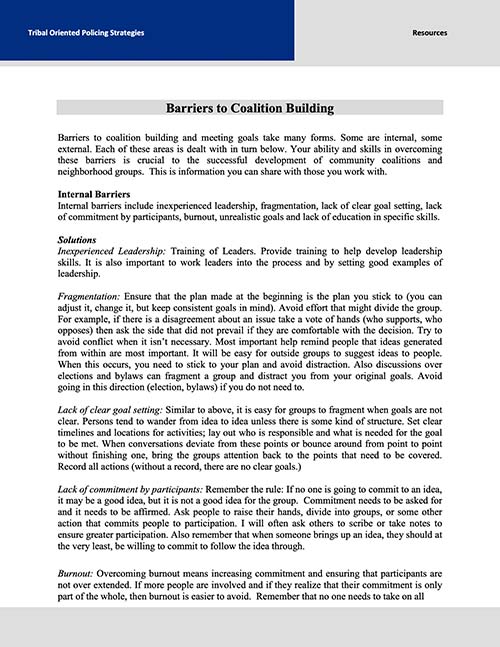
This document describes barriers to coalition building and recommended solutions to overcome the barriers.