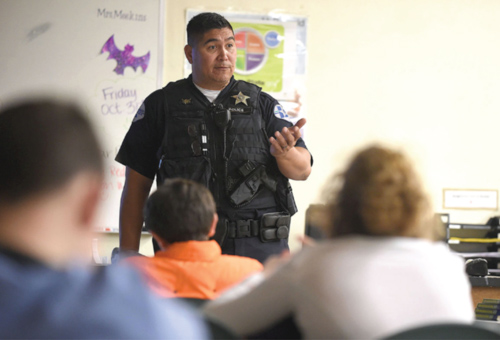
Join other law enforcement and school personnel to address school violence and youth victimization concerns through the use of crime prevention and response strategies and review lessons learned from relevant case studies. Examine the impacts of trauma on youth and effective strategies for working with students experiencing mental illness and learning disabilities. Explore the most current trends among youth relating to social media and alcohol and substance abuse. Discuss successful prevention and intervention program models.

Join us to learn about various strategies designed to assist tribal SORNA programs with providing information on sexual offenders and offending to community members.

Gain an introduction into the psychology, or mindset, of those that commit sexually motivated crimes. Learn about sex offender typologies and patterns of behavior. Explore the relationship between paraphilia such as exhibitionism, voyeurism, and fetishism and criminal acts. Review and dissect real case examples to gain insight into offender modus operandi. Knowledge obtained can be applied during interview and interrogation to help resolve sexually motivated cases.

Join us to learn about office and field techniques to maintain safety during sex offender registration.

Many Native Americans on Tribal probation have a conviction or history of domestic violence. In fact, many have a history of multiple convictions and have demonstrated no inclination to change their violent behavior. Tribal probation departments often struggle with how to supervise domestic violence offenders, and where to refer them to for rehabilitative services. In the meantime, victims and the community remain at risk from these offenders. Learn the problem of domestic violence within tribal communities and explore ways to assess the risk of these offenders to commit further acts of interpersonal violence including lethality to the victim. There are a number of risk assessment instruments and research-supported risk factors that can help probation officers to better supervise and monitor these offenders. Research shows that the best way to reduce domestic violence reoffending is a combination of supervision and treatment strategies.

Examine identifying factors that contribute to dangerousness for further sexual offending on the part of registered sex offenders. Learn how to gather and review relevant information on registrants from other collateral sources and share information with multidisciplinary team members, and what specific investigation and observation skills can be employed to identify these factors. Discuss community based team supervision and offender safety planning and develop team strategies. Develop advanced techniques for sex offender registration and monitoring.

Combat recidivism and sexual violence posed by sex offenders based on management and treatment best-practices. Learn how treatment, supervision, law enforcement, and the community at large can increase the offender's chances of a pro-social non-offending lifestyle. Explore response strategies for adults and juveniles who commit sexual offenses.

Are you responsible for monitoring or supervising sex offenders within your community? Have you reviewed current data or trends related to sex offenders and offending behaviors? Chris Lobanov-Rostovsky shares three critical things that law enforcement personnel should know about sex offenders.

Have you considered the core correctional principles of sex offender management for supervision officers, law enforcement, and treatment providers? Have you incorporated national trends and evidence-based practices in sex offender management? Chris Lobanov-Rostovsky shares three critical things to consider in sex offender management to enhance public safety and reduce recidivism.

Examine the framework to successfully manage interpersonal violence offenders including those who commit sex crimes, while providing for the safety, rights, interests, and needs of victims/survivors. The fundamental principles of the Comprehensive Approach include victim/survivor centeredness and multidisciplinary collaboration, which requires professionals working with the offender to provide a mechanism for victim/survivor representation on supervision teams. In addition, offender management strategies should also be designed to meet the specific, individualized needs of victim/survivors. The Comprehensive Approach emphasizes the importance of utilizing evidence-based interventions to reduce risk, target criminogenic needs, and prevent recidivism. Gather best practices for sex offender management and victim/survivor centered practices as well specific offender and victim/survivor programmatic examples.